



The U.S. Department of Energy (DOE) and Pacific Northwest National Laboratory (PNNL) developed the Single-Family Market Characterization Field Study methodology to provide in-depth empirical analyses of regional residential new construction practices, consumer preferences, and market dynamics. These field studies help identify and validate market trends by capturing real-world data on emerging technologies, design preferences, and building practices directly from active residential projects. Unlike data from national sources, field studies uncover local and regional trends, offering unique insights.
By analyzing data collected from field observations, field studies allow stakeholders to evaluate what is working well in practice, ensuring proven technologies and methods are recognized, and identifying opportunities for improvement where barriers arise. These studies provide information that can be used for more targeted training for the homebuilding industry. Furthermore, field studies serve to show the impacts of building codes by quantifying consumer cost savings potential through reduced energy bills. These efforts ensure that both industry professionals and policymakers are equipped with actionable and localized insights to drive innovation and improve residential construction outcomes. DOE encourages states to conduct these types of studies every 3-5 years, or in conjunction with an energy code update, to investigate impacts of energy codes and other energy-efficiency initiatives, identify training opportunities, and benchmark technology trends in residential construction.
States are encouraged to conduct these types of studies every 3-5 years, or in conjunction with an energy code update, to validate impacts of energy codes and other energy-efficiency initiatives, identify training opportunities, and benchmark technology trends in residential construction.
Recent Single-Family Field Studies
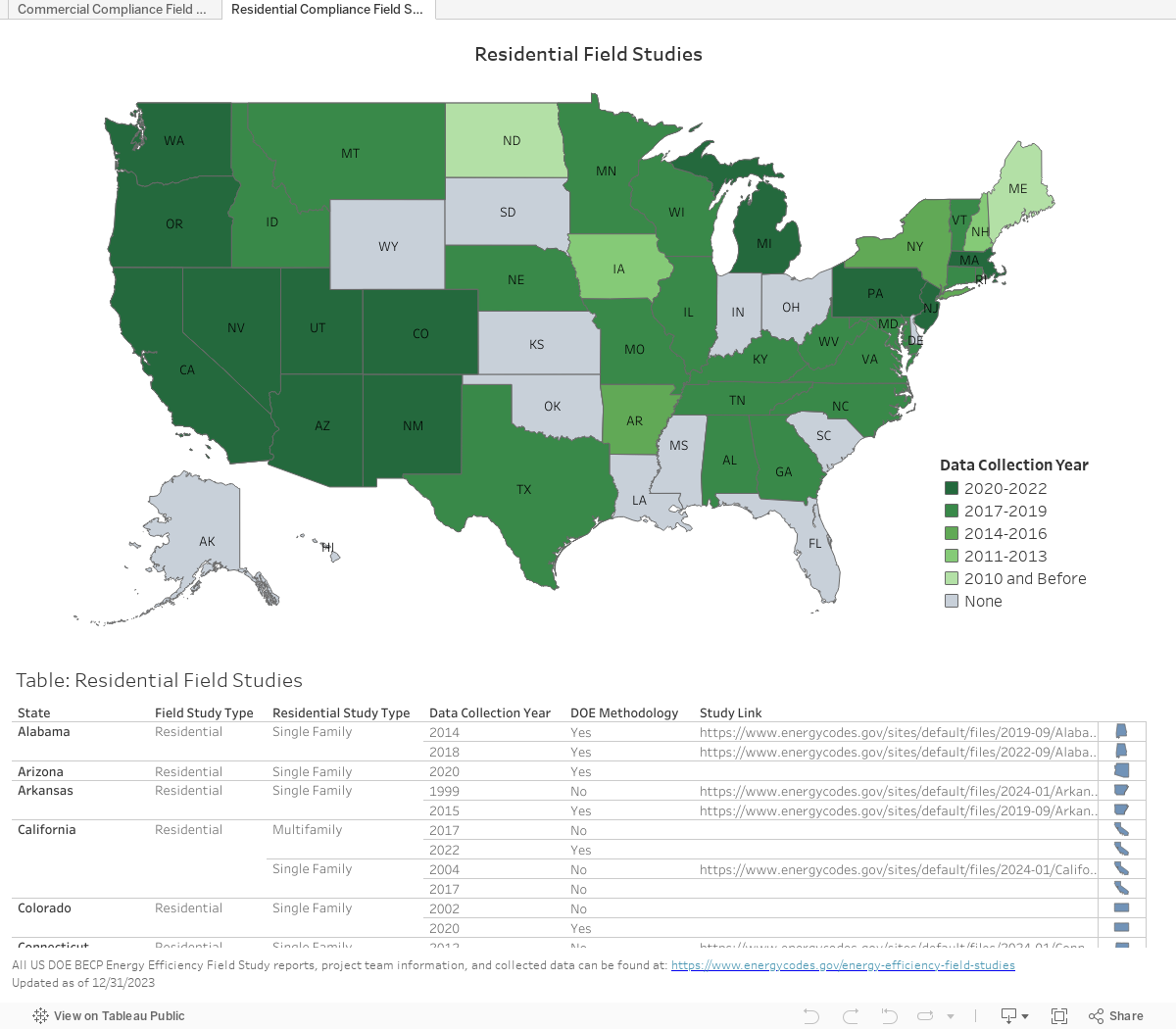
The map below highlights states that have conducted single-family field studies. The vast majority of these states utilized the Single-Family Market Characterization Field Study Methodology. In those states, a DOE report and a full set of compliance data is available. To find out more about each state’s study or studies, click the state map or explore this BECP Tableau Public Dashboard for an interactive experience.
Methodology
The methodology involves collecting data from a random sample of homes from within a random sample of jurisdictions to yield statistically valid insights into housing characteristics that impact energy consumption. Project teams collect data in the field from homes that are under construction to better understand recent construction trends in a state or other geographic region. Surveyors record information on a broad set of home characteristics with the primary analysis focusing on a subset of characteristics referred to as “key items”. These key items are construction elements that have the largest impact on a home’s energy consumption.
The methodology was first developed as part of a seven-state pilot research program with an objective to determine whether an investment in energy code education and training programs can produce a significant, measurable change in energy savings for single-family residential buildings. The pilot studies included a baseline field study, an intervention (industry training and education), and a post-intervention field study. These studies demonstrated the effectiveness of industry training and education in improving energy efficient construction practices.
Since then, DOE has focused on supporting baseline field studies and industry training and education with a reduced emphasis on post-intervention field studies, due to the proven effectiveness of training and education and the goal of reducing study costs.
Field studies are typically collaborations between PNNL and external project teams. PNNL typically provides sampling plan options at the start of a study, and analysis and reporting at the end. In between, project teams identify and recruit homes to participate in the study and collect field data. All data is anonymized prior to being provided to PNNL for analysis, which consists of three parts: statistical (descriptive) analysis, energy analysis, and savings analysis.
- The statistical analysis provides descriptions of key item observations, including histograms showing the distribution of observed values, averages, ranges, and the percentage of observations above or below a prescriptive baseline.
- The energy analysis involves running thousands of simulations based on observed data to estimate the average home's energy use intensity (Btu/ft2) and compare it to a baseline energy use intensity.
- The savings analysis looks at all observations that did not meet baseline criteria and estimates the potential energy and dollar savings if all observations met baseline criteria.
More information on the field study methodology and supporting research instruments is available below. Technical assistance is available from PNNL, including guidance on the established methodology, customization of sampling plans, and technical analysis of the resulting data set.
Participating States
The following states conducted at least one baseline field study using the DOE methodology:
Pilot Studies:
- Alabama (Phase I, Phase III)
- Arkansas (Phase I, Phase III)
- Georgia (Phase I, Phase III)
- Kentucky (Phase I, Phase III)
- Maryland (Phase I, Phase III)
- North Carolina (Phase I, Phase III)
- Pennsylvania (Phase I, Phase III)
- Texas (Phase I, Phase III)
Baseline Studies:
- Arizona (coming soon)
- Colorado (coming soon)
- Idaho (new study coming soon)
- Illinois (report not requested)
- Iowa (coming soon)
- Michigan(new study coming soon)
- Missouri (report not requested)
- Montana (new study coming soon)
- Nebraska
- Nevada (coming soon)
- Oregon
- South Carolina (coming soon)
- Tennessee
- Utah (coming soon)
- Virginia
- West Virginia (report not requested)
New Baseline Studies Underway:
- Georgia
- Louisiana
- Wisconsin
Field Study Resources
- Methodology Document
- Singe Family Residential Field Study Toolkit
- Data Collection Instruments
Field Study Datasets
- Pilot Study Data
- Other State Data
- Residential Energy Code Field Study Dashboard