



Commercial Buildings
The U.S. Department of Energy (DOE) and Pacific Northwest National Laboratory (PNNL) developed the Commercial Building Market Characterization Field Study methodology to provide in-depth empirical analyses of regional commercial new construction practices, building owner preferences, and market dynamics. These field studies help identify and validate market trends by capturing real-world data on emerging technologies, design preferences, and building practices directly from active commercial projects. Unlike data from national sources, field studies uncover local and regional trends, offering unique insights.
By analyzing data collected from field observations, field studies allow stakeholders to evaluate what is working well in practice, ensuring proven technologies and methods are recognized and identifying opportunities for improvement where barriers arise. These studies provide information that can be used for more targeted training for the building industry. Furthermore, field studies serve to show the impacts of building codes by quantifying building owner cost savings potential through reduced energy bills. These efforts ensure that both industry professionals and policymakers are equipped with actionable and localized insights to drive innovation and improve commercial construction outcomes.
DOE encourages states to conduct these types of studies every 3-5 years, or in conjunction with an energy code update, to investigate impacts of energy codes and other energy-efficiency initiatives, identify training opportunities, and benchmark technology trends in commercial construction.
Recent Commercial Field Studies
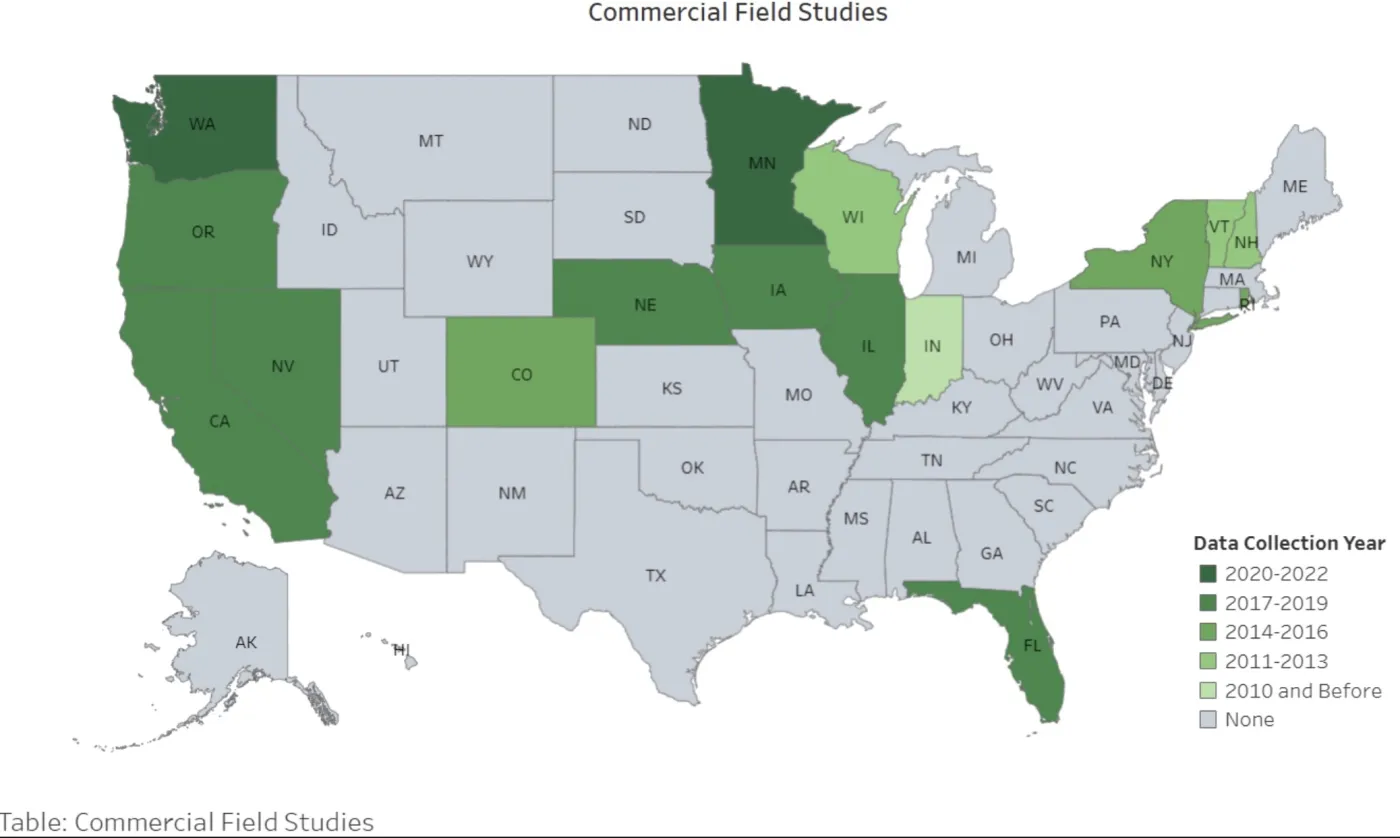
The map below highlights states that have conducted commercial field studies.
Methodology
The detailed methodology, which includes the data collection protocol, sampling plan approaches, key measure descriptions, building types, and code references, is available below. In addition, the data collection forms which are described in detail in the methodology are also available.
The DOE Commercial Building Market Characterization Methodology applies to retail, office, school, and warehouse buildings in Climate Zones 1–8 across all moisture regimes. For each data item, the study records (1) the baseline value, (2) the value shown on the construction documents, and (3) the value observed in the field. Energy-simulation–based regressions are then used to calculate “lost savings” when observed conditions do not meet the baseline. Lost savings are estimated both for the whole building and for individual measures.
Highlights from the methodology include:
- DOE identified roughly 70 key measures to study based on their significant contribution to building energy use
- Flexibility in sampling plan development and describes the necessary number of observations for statistical significance
- Analysis of lost energy and cost savings associated with not meeting baseline criteria
- Measures based on highest overall savings potential
Methodology and Data Collection Protocol (01/2023)
Field Data Collection Tools
The data collection form is dynamic: it highlights different items depending on climate zone, occupancy type, and the building’s heating, cooling, and hot water system types.
- Field Data Collection Forms (09/01/21)
- Supplemental Worksheets (09/01/21)
Prior Commercial Building Research
In 2015, DOE developed a methodology to assess the energy impacts of non-compliance and piloted the methodology in nine office buildings in climate zone 4C. This pilot study was later expanded to four states and two climate zones through a DOE FOA in 2016. The objective, methodology, and key findings from this effort are described below. While the data collected were not sufficient to yield statistical significance, this study provides critical insight into building level energy code compliance and guidance to which individual measures have the highest lost savings.
Results: The project team visited 230 buildings, covering over 6 million square feet of commercial office and retail space, in climate zones 2A and 5A. The lost energy cost savings as found during the field study was $189 per thousand square feet, with present value of $2,868 per thousand square feet, on average across all the buildings. The actual lost savings are likely underestimated, as only 69% of the applicable measures could be field verified due to site visit timing. Only four buildings were fully compliant with the energy code and had zero lost savings. Lighting controls and HVAC controls provide some of the largest as-found lost energy cost savings. To help prioritize inspection resources, the study assessed measures based on lost savings per total hours invested in verifying the measures in the field. The top five measures based on that assessment include: 1.) ERV Use, 2.) Mechanical Commissioning, 3.) Service Hot Water Pipe Insulation, 4.) Automatic Time Switch Control, and 5.) Lighting Commissioning and Functional Testing.
Final Technical Report:
Data Analysis of Energy Code Compliance in Commercial Buildings (01/2023)
Related Studies
Development of Lost Energy Cost Savings for Energy Code Compliance in Commercial Buildings (12/01/2020)
Implementation of Energy Code Controls Requirements in New Commercial Buildings (03/01/2017)
An Approach to Assessing Potential Energy Cost Savings from Increased Energy Code Compliance in Commercial Buildings (02/01/2016)
Commercial Building Energy Code Compliance Literature Review (02/01/2016)